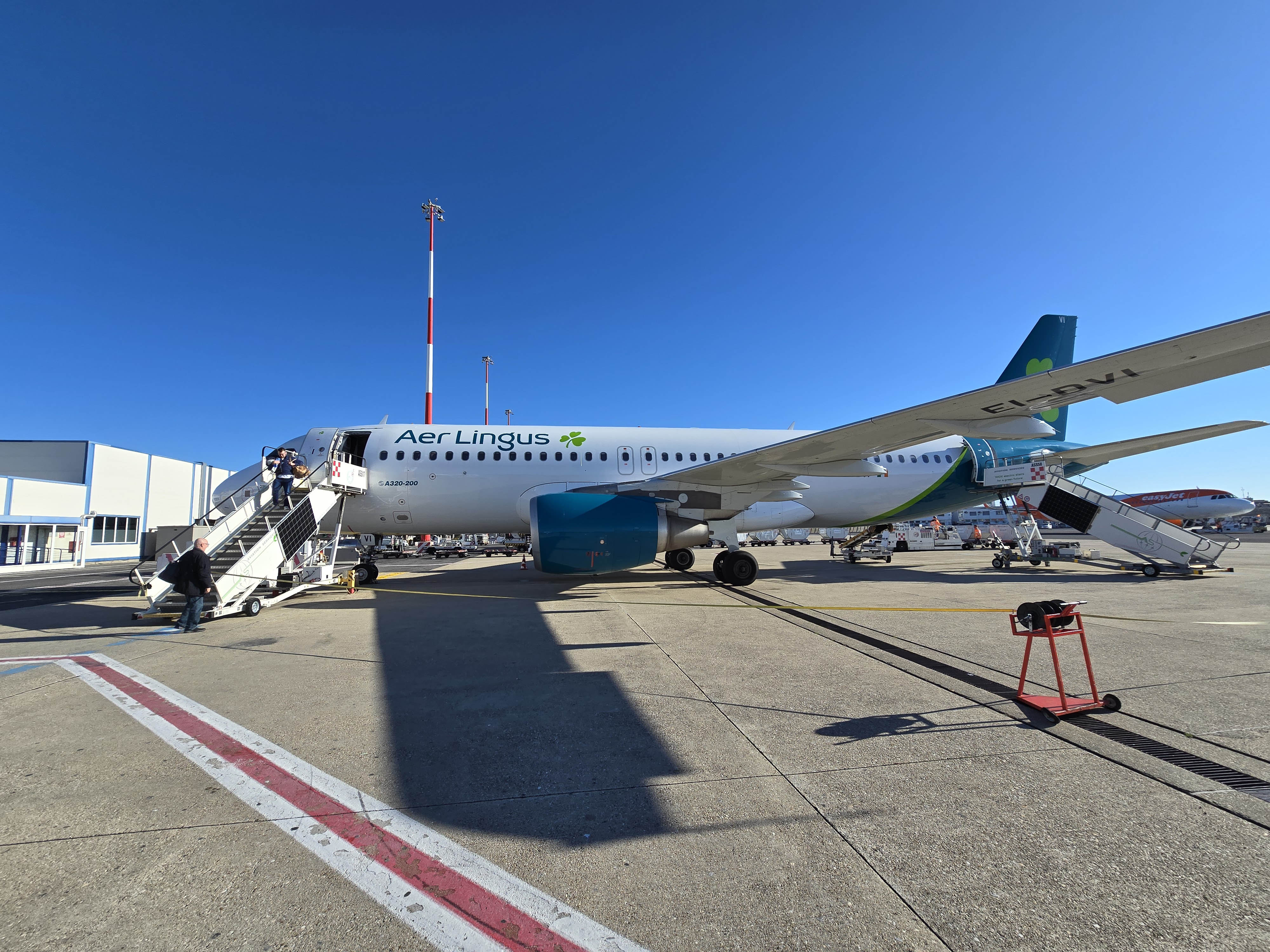
When flying transatlantic to Europe, many strategies are often considered. There are the loyalists who refuse to fly anything other than Delta, KLM, Lufthansa, or the likes. Then there are the budget travelers who jump at the low-fares of Tap Portugal or the now-defunct Play Airlines only to find out they will be subjected to clearing customs in multiple countries (often with long lines and delays), a long layover on the return flight (looking at you SAS, a la your 15 hour overnight layover in Copenhagen – which honestly, Copenhagen is on my travel list anyway so I’m sure I will bite on this one day), and I haven’t even mentioned the Spirit-Esque fees for literally anything and everything. If you are a loyalist, maybe I can persuade you to give the little guy a try for once. If you are still fuming at your three hour customs experience, 10 euro miniature cup of airline water, and long layover on the return – all in the same trip – I have a few ideas as well. Meet Aer Lingus, the flag carrier of Ireland.
I’ve now crossed the Atlantic a handful of times with the flying shamrock and they are now the first airline I consider when flying from the US to Europe. I promise this isn’t just my quarter-Irish speaking, or the fact that I’m flying often from Boston, with a very strong Irish population. Aer Lingus may not offer the eye-popping cheap prices that Play once did (before all the fees), but they are generally cheaper than the Air France, KLM, and Delta’s of the world. Transiting to Europe via Aer Lingus also includes stopping to change planes in Dublin and “customs” (more on why this is in quotes later), but all of my experiences so far have been an absolute breeze. I find Aer Lingus to be an excellent choice in between the two extremes (loyalist and budget) and my only complaint is about their new livery – I loved seeing the fully-green a330 pull into terminal C in Boston, and the new mostly white livery just isn’t the same. But I digress…without further ado, let’s explore Aer Lingus.
Why Aer Lingus is a Travel Hack TLDR
1. US Preclearance in Dublin – HUGE. Dublin Airport has US customs at the airport, meaning, after your transatlantic flight back to the US, you can just walk off the plane and head home without waiting in any more lines.
2. Smaller Airport Experience – Dublin Airport is much smaller and easier to navigate than the likes of London Heathrow or Charles De Gaulle.
3. Competitive Transatlantic Pricing – Not as cheap as some, but certainly less expensive than others.
4. Convenient East Coast Routes and Connectivity to Many European Destinations.
5. Comfortable Airbus Fleet – Their Airbus A330 is my personal favorite choice.
Why Aer Lingus is a Travel Hack (The Long Version)
US Preclearance in Dublin
You don’t often realize how wonderful this is until you’ve found yourself running through Atlanta’s Hartsfield-Jackson International Airport because Delta gave you less than two hours to make your connection and the customs process was taking roughly 1:45 that particular night. Oh, and did I mention the international terminal is a few miles away from the terminal we were headed to? When transiting through Dublin on the way back to the US, you will clear US customs before boarding your flight in Dublin, meaning, there will be no customs to go through when you land in the US. The lines and wait times are much shorter than average customs times in US airports. One small note, once you clear US Preclearance there is not much in the section of the terminal for US-bound flights except for a small café (where of course you can still get a pint of Guiness) and a small souvenir stand.
Smaller Airport Experience
Aer Lingus clearly has an international strategy. With a large number of Us to Ireland flights scheduled to land early in the morning Dublin time (my most recent Aer Lingus flight to Dublin landed around 4 AM), Aer Lingus strategically schedules connections throughout Europe departing Dublin within a few hours. In essence, Dublin functions almost like a sorting center with US and European passengers in mind. I’ve had some pretty tight connections changing planes while also going through customs, but Dublin could not have been any easier. Gone are the days of deplaning, going through customs, arriving in the arrival hall, going back to bag drop and passing through security again, only to end up right back at the gate next to the one you first arrived at (Looking at you YYC – albeit roughly 15 years ago), at least in Dublin.
Even deplaning at 4 AM, there were several very helpful Dublin airport staff guiding people through the transfer process. The staff were excellent, but there were also signs everywhere. First, you follow the signs and staff to the designated area for connecting flights where you are sorted by your final destination: UK or Schengen/EU. I can’t speak to the UK customs process, but for all other EU destinations, all you have to do is scan your onward boarding pass at an automated gate and walk right through – Welcome to Dublin…well, at least Terminal 2! After walking through a few more halls, you find yourself back in the terminal headed towards your next gate. Easy! No customs or security lines, no hassle – at least not in Dublin. Unfortunately, they can’t guarantee the same at your next airport. I can also attest the process to be exactly the same on the return trip with only the added US Preclearance mentioned above. With all the extra time before your next flight, grab a snack, or maybe find a fresh pint of Guinness from, well, literally anywhere in the airport – just another small perk of going through Dublin.
Competitive Transatlantic Pricing
First, I will start out with a disclaimer, noting I did not say “best” transatlantic pricing as an absolute. As I’ve mentioned above, Aer Lingus seems to slot in around the midpoint of options comparatively with other airlines, but in many cases can be cheaper or as expensive. In my experience, I have flown Aer Lingus from Dublin back to the US (cheapest price from Dublin to Boston on that date, ~$200 less than Delta), roundtrip from Boston to Rome for ~$470 (once again, less than competitors), and will be using Aer Lingus again in the near future. However, I have seen some Aer Lingus flights to Italy at $600 to $700, which is obviously higher than $470, but honestly very similar with the other airlines for those weeks that I have been exploring. There are a few outliers as SAS has an offered price for those dates of $454 (but their website keeps crashing), British airways has a few flights around $550 (but once you finish picking your seats and adding even just one bag it comes out closer to $700), Delta has a $800 starting point, and of course there’s that very enticing Lufthansa flight with a one hour layover in Frankfurt for $1,033. As I said, Aer Lingus does not always have the cheapest price you will see, but they are generally quite competitive.
Additionally, the lowest “saver” fare on Aer Lingus actually gets you pretty far without having to pay for addons. Seat selection comes at an additional cost (prices comparatively cheaper than some of the other airlines), but one carry-on sized suitcase and one backpack are included in the base fare (Ryanair would never!) In summary, I look at Aer Lingus like I look at JetBlue: it might be cheaper or might be pretty much the same price as the others, but I appreciate the value.
Convenient East Coast Routes and Connectivity to Many European Destinations
I’ve kind of already hinted at this above in the last few sections, but Aer Lingus offers a pretty strong network of US-Europe connections. On the American side, Aer Lingus flies to 18 US destinations at the time of writing, including bigger airports such as JFK, Boston San Francisco, and Chicago, but also some smaller airports such as Hartford. From Dublin, Aer Lingus offers an extensive list of connections throughout Europe.
Comfortable Airbus Fleet
Aer Lingus operates a fleet comprised of Airbus A320, A321, and A330 with the A330 and A321 used on transatlantic routes. I will go into the in-flight experience later, but I find their A330 to be very comfortable, especially with the 2-4-2 seating arrangement in economy. A small percentage of regional routes are operated on ATR 72-600’s, but I can’t speak to that experience as I have yet to have the opportunity to fly on one.
History and Background
Aer Lingus has a long and fascinating history closely tied to Ireland’s growth as a modern nation and its connections to the wider world. The airline was founded in 1936 by the Irish government with its first flight operating between Baldonnel Aerodrome in Dublin and Bristol in the United Kingdom. In its early years, Aer Lingus operated small propeller aircraft and primarily connected Ireland with nearby destinations in the UK. As air travel expanded after World War II, the airline gradually grew its network and modernized its fleet, becoming an important gateway between Ireland and Europe.
Aer Lingus entered the transatlantic market in 1958, launching service between Ireland and the United States using long-range aircraft. These routes quickly became a core part of the airline’s identity, connecting Irish communities abroad with their homeland while also bringing tourists and business travelers across the Atlantic. Over the decades, Aer Lingus continued to evolve, transitioning from propeller aircraft to jet-powered fleets and expanding service throughout Europe and North America. Today, the airline operates a modern fleet of Airbus aircraft and remains one of the most recognizable brands in Irish aviation, known for its distinctive green livery and strong transatlantic network.
Destinations
At the time of writing, Aer Lingus flies to 106 international destinations in 27 countries and five domestic locations.
What to Expect
Ok, you’ve booked that flight on Aer Lingus! Here’s what to expect.
Checking In
I recommend downloading the Aer Lingus app. Checking in opens 24 hours prior to your flight time and I found the process to be quite simple using the app. Aer Lingus also offers a full-service counter at the airport.
Luggage
The basic saver fare on Aer Lingus offers a personal item such as a backpack and a carry-on sized suitcase. If expecting a need for larger or more luggage, they offer the ability to pay for additional or larger pieces individually, or upgrade the fare for higher allowances. One thing to note, on transatlantic flights the saver fare includes a carry-on bag, but for individual flights within Europe, the saver fare includes a checked bag. Read the fare inclusions and you will be just fine – it’s just a nuance that I find interesting as it is the same sized bag allowance, just a difference on where it goes on the plane. For clarification, if you book a flight to or from the US, the saver fare includes a carry-on for the entire trip (you don’t need to do some funky bag drop in Dublin when connecting). Regardless of how your travels with you, I find it nice that Aer Lingus at least includes luggage options in their lowest level fare.
The Plane
As I mentioned above, Aer Lingus primarily operates Airbus aircraft. So far, I have been on their A320, A321, and A330 aircraft. The A330 is by far my favorite aircraft they fly, but the A320 and A321 are comfortable as well. I would say for transatlantic flights, the difference in comfort level is noticeable when speeding across the Atlantic on the smaller A321 instead of the A330.
The Seats
Overall, the seats are decently comfortable, and I would say they compare equally to most of the other airlines. They are definitely more comfortable than the budget airlines who seemingly wrap a seat-frame in the thinnest fabric ever invented. Once again, the planes configured for transatlantic flights have slightly more comfortable seats than the European flights, but by no means have I had an uncomfortable experience.
How's the Legroom?
Industry standard – as a 6’2” man, I have absolutely no complaints. I have been on plenty of flights with much worse legroom and some with more (Hi, JetBlue!), but I find the legroom on Aer Lingus to be perfectly fine. I have never had an issue with my knees hitting the seat in front of me, and I can easily stretch out my legs without feeling cramped.
In-Flight Entertainment
Aer Lingus offers two different entertainment configurations. On transatlantic flights, you will find seat-back screens packed full of movies, shows, podcasts, music, games, and an interactive map. On flights within Europe, there is no in-flight entertainment, so I recommend packing a book or enjoying the incredible views with a window seat. It is worth noting that Wi-Fi is only available for a fee.
Refreshments
While many airlines are cutting back on their in-flight service, Aer Lingus still includes full service on transatlantic flights. Their service includes a hot meal, complimentary offering of beer or wine (additional alcoholic beverages for purchase), coffee and tea, non-alcoholic beverages, and a snack before landing. On flights within Europe, snacks and beverages are only available for purchase, but water is complimentary.