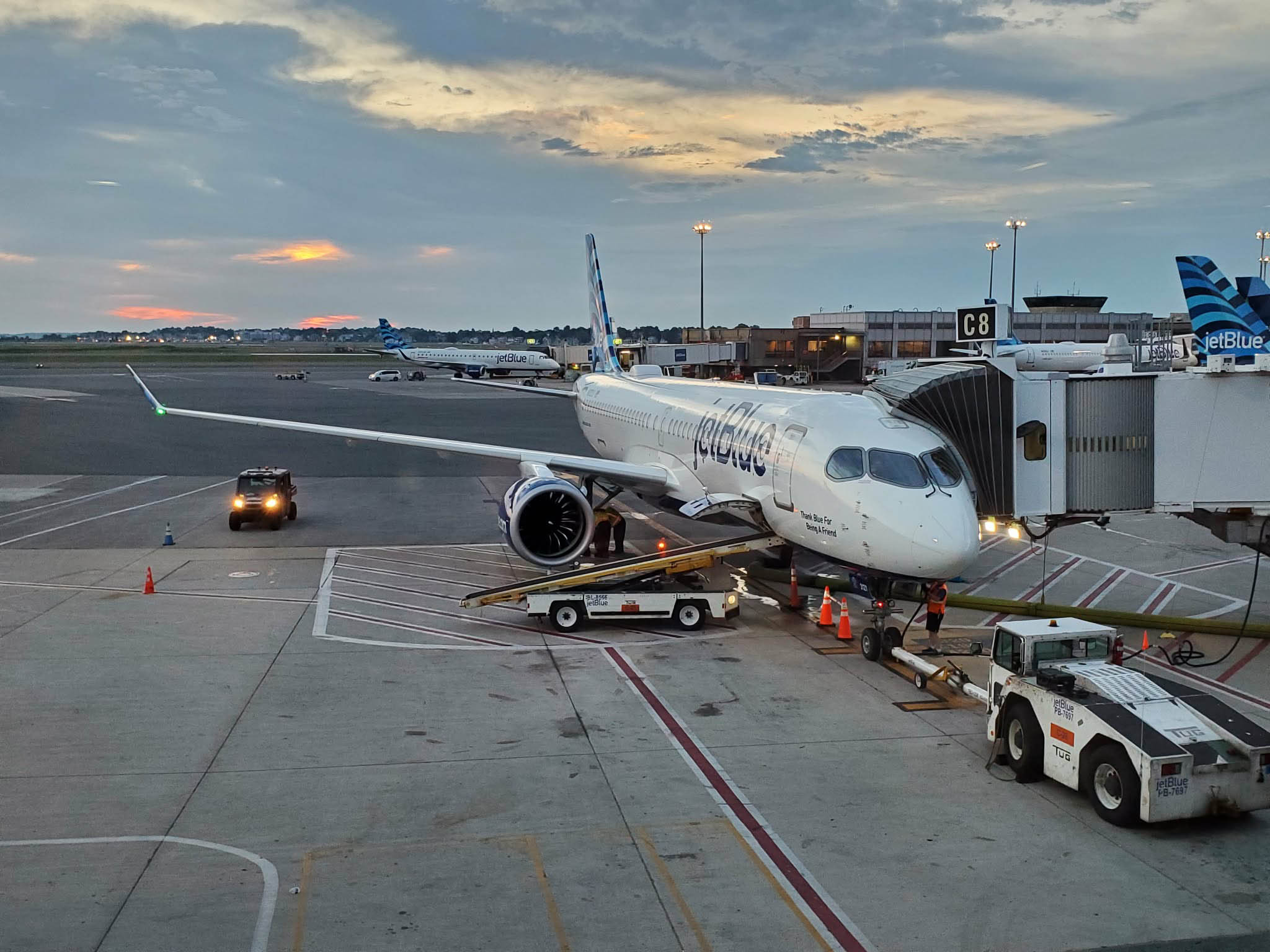
When it comes to JetBlue, a quick scroll through online social media seems to present two polar opposites: people either love them or hate them. I happen to be very strongly seated in the former as, without a doubt, JetBlue is truly my favorite U.S. airline. Maybe it all started out of convenience as I was regularly flying between the Washington, D.C. area and Boston, but maybe there’s just something about the airline that I find irresistible. Years ago, JetBlue operated flights out of all three major DMV (DC, MD, VA) airports, so finding a cheap fare had three times the options. Sadly, through route consolidation, JetBlue only operates to DCA now, but I find myself regularly flying with JetBlue all around the country and across the Atlantic.
To me, JetBlue has been in a unique, albeit sometime precarious position as an Airline. What started as a budget airline in the late 1990’s, JetBlue has seen tremendous growth and changes over the years. JetBlue outgrew their humble budget airline beginnings and seemed to pivot their strategy to compete more with the “big boy” US airlines. Unfortunately, a lot of these initiatives and moves launched only a few years before COVID and it feels like they have been working to recover ever since. Financially, things have not always been peachy as of late, leading to a large number of routes being cut, but I still have never once had a less than wonderful experience flying JetBlue. Constantly finding themselves somewhere in between the Spirit and Frontier’s and the Delta’s of America, JetBlue has a lot of things going for them to make you ready to go all in on TrueBlue.
Five Things I Love About JetBlue TLDR
1. Best legroom in economy in the U.S.
2. Extensive in-flight entertainment, Wi-Fi, and service
3. Competitive pricing and rewards program
4. Strong east coast route network from Boston and New York, but also growing presence in other markets
5. Comfortable Airbus fleet - I LOVE the news A220's
Five Things I Love About JetBlue (The Long Version)
Best Legroom in Economy in the U.S.
If you’ve read any of my other reviews, you’ll notice one measurement I always use in comparing airlines is legroom when sitting in economy. I always say, “as a 6’2” man” – but seriously, JetBlue has the most spacious legroom I have ever had in just basic economy seats. When going from one airline back to JetBlue, the extra legroom is instantly noticeable, not just an insignificant afterthought. In fact, JetBlue has long been known for their legroom, boasting 32 to 33 inches in economy and around 38 inches in their “Even More Space” seats. Unlike many other airlines who have cut back every possible inch of legroom, JetBlue has maintained their status as the number one US airline for legroom. Next time you see or hear one of their ads boasting about their legroom, just know it is not an empty promise to entice you, but an actual guarantee. JetBlue stands out even more because not only do they deliver premium legroom, but also comfortable seats, an extensive in-flight entertainment system, and tremendous service – but much more on that next.
Extensive In-Flight Entertainment, Wi-Fi, and Service
Just in case legroom wasn’t enough to sell you on the JetBlue experience, let’s discuss some of the other perks they offer while aboard one of their flights. While it wasn’t long ago that in-flight entertainment consisted of the reading light above your seat or entertainment screens only on long, international routes, JetBlue has been consistently offering an in-flight entertainment experience above and beyond many of the other airlines for years.
When I first started flying with JetBlue about 15 years ago, their E190 jets already had in flight entertainment. Think about that for a moment – In the past two years I have flown routes with American, Alaska, and United where they had absolutely nada, and yet JetBlue has been doing it for decades, starting on planes they’ve already retired. Their early in-flight entertainment systems did not have movies, shows, and music on-demand, but offered 3 or so channels of live TV. Today, JetBlue offers all the on-demand content but still has live TV as well (at least on US routes). If you haven’t seen the pictures on social media, I highly recommend looking up what JetBlue flights across the country with a destination of Boston looked like during the 2026 Super Bowl (although, Pats fans may have wished live TV was unavailable after the first few drives of the game!)
JetBlue also offers free in-flight Wi-Fi for TrueBlue rewards members. If you are already part of their rewards program (more on that to come), you simply sign into your account and voila – you’re connected. If you’re not a TrueBlue member yet, signing up is simple and free – you’ll be unlocking Wi-Fi perks and earning rewards points in no time.
In addition to JetBlue’s in-flight entertainment, their service offerings feel like a step above as well. JetBlue does offer meals and additional items for purchase, but their complimentary snack and beverage options are quite nice in comparison to other airlines. While some airlines will not even offer you complimentary water (*cough cough* Spirit) and others offer you one beverage and a Biscoff cookie (I’ll admit, it is iconic), JetBlue carries an entire basket of snacks down the aisle that include crackers, chips, granola bars, and a few other selections to choose from. Often times, they even give you two packages of plantain chips or Cheeze-It’s. We haven’t even mentioned JetBlue’s transatlantic service to a handful of destinations in Europe, but if you’re jetting across the Atlantic, JetBlue offers a full meal service as well.
With all the additional legroom, entertainment options, and snacks, I enjoy the TrueBlue experience on every flight.
Competitive Pricing and Rewards Program
Pricing
JetBlue’s pricing strategy tends to fall somewhere in the middle of the airline spectrum. In many cases, fares are cheaper than the large legacy carriers such as Delta, American, and United, while still offering more amenities than ultra-low-cost airlines like Spirit or Frontier. This middle-ground approach has become a key part of JetBlue’s brand: offering a more comfortable experience without the premium price tag often associated with traditional airlines.
In practice, JetBlue flights are often competitively priced with other airlines on popular domestic routes, especially along the East Coast and to destinations in Florida and the Caribbean. Depending on the route and time of year, JetBlue can be slightly cheaper than its larger competitors while still including perks such as the above mentioned free Wi-Fi, complimentary snacks, and seatback entertainment amenities that many airlines now charge extra for or have removed entirely.
That said, JetBlue is not always the cheapest option available. Ultra-low-cost carriers can occasionally advertise lower base fares, though those prices often increase quickly once additional fees for bags, seat assignments, and other services are added. Similarly, the larger airlines may advertise a higher base fare but have less additional fees.
One area where JetBlue can sometimes be more expensive is in optional fees. Checked baggage and seat selection costs can add up depending on the fare type and route, meaning travelers should pay attention to what is included in their ticket. JetBlue offers multiple levels of fares, where Blue Basic does not offer seat selection, checked bags, and boards last (where you are much more likely to have to gate check your carry-on when they run out of overhead space), but their fees for seat selection are often very fair and I get around the checked bag fees with the JetBlue credit card (once again, more to come), where checked bags become free. Often, the non-refundable Blue Basic fare plus the add-on fee to select my seat in advance (yes, I’m picky) is still cheaper than the legacy airlines and is more than enough to get the job done. Don’t just take my word for it - many passengers still find JetBlue offers strong overall value thanks to its comfortable cabins, extra legroom, and onboard amenities.
Rewards Program
JetBlue’s frequent flyer program, called TrueBlue, is designed to be simple and easy to use compared with many traditional airline loyalty programs. Members earn points based primarily on how much they spend on tickets rather than how far they fly, which makes the program straightforward for travelers to understand. Points can then be redeemed for flights on JetBlue and select partner airlines.
One of the most appealing features of the TrueBlue program is that its points are tied directly to ticket prices through a dynamic pricing system. When cash fares are lower, fewer points are required to redeem a flight, making it easier for travelers to use their rewards without worrying about blackout dates or complicated award charts. JetBlue points are commonly valued at around 1.4 cents each, making them competitive with other major U.S. airline loyalty programs. For comparison, I have seen domestic flights on JetBlue offered at less than 4,000 points, meanwhile I am still miles upon miles away from ever redeeming a flight on Delta.
Members can earn points not only through flying, but also through JetBlue’s co-branded credit cards, travel partners, and everyday purchases. Frequent travelers can also earn Mosaic status, which provides benefits such as priority boarding, complimentary seat upgrades, and additional perks while flying. The JetBlue Plus card comes with a $99 annual fee, but offers a qualifying offer of 60k to 70k points, one free checked bag on all flights for the cardholder plus up to three travel companions (remember earlier when I mentioned how to not pay for checked bags?), in-flight purchase discounts, and higher earning rates for points.
Overall, the TrueBlue program focuses on simplicity and flexibility rather than complex mileage calculations. For travelers who frequently fly JetBlue, the program offers an easy way to earn rewards and reduce the cost of future trips.
Strong East Coast Route Network from Boston and JFK
Although JetBlue has seen some pretty drastic reductions and cutbacks of routes in recent years, JetBlue still offers a strong network from the east coast. JetBlue is well connected from Boston Logan and New York JFK throughout all of their domestic and international destinations. Not just their strong leisure and Caribbean network, JetBlue also offers nonstop flights to a handful of destinations in Europe, including London, Amsterdam, Paris, Dublin, Edinburgh, Madrid, and recently announced Barcelona and Milan. I have personally flown JetBlue throughout the US on regional and cross-country flights, and across the Atlantic to London. Admittedly, other airlines have a larger network of routes with more aircraft and international connectivity, but from Boston and New York, JetBlue is an excellent option more often than not.
Comfortable Airbus Fleet
JetBlue operates a fleet comprised of Airbus A320, A321, and most recently, the new A220 aircraft. JetBlue used to fly the Embraer E190’s, but have retired them in favor of the modern A220’s. I have had the pleasure of experiencing all of the aircraft types JetBlue operates, with the A220 being my personal favorite for their 2-3 seating configuration and large windows.
History and Background
JetBlue was founded in 1998 by entrepreneur David Neeleman (now with Breeze Airways) with the goal of creating a new type of airline that combined low fares with a more comfortable passenger experience. The airline began operations in 2000 with its first flights departing from New York’s JFK Airport. From the beginning, JetBlue focused on offering features that were uncommon at the time for a low-fare airline, including leather seats, more legroom than most competitors, and seatback televisions for every passenger.
Throughout the early 2000s, JetBlue expanded rapidly across the United States, building strong networks in New York, Boston, and Florida while also adding routes to the Caribbean and Latin America. The airline continued to emphasize customer experience as a differentiator, introducing free snacks, friendly service, and later becoming the first U.S. airline to offer free high-speed Wi-Fi across its fleet.
Today, JetBlue is one of the largest airlines in the United States and operates a modern fleet primarily made up of Airbus aircraft, including the A220, A320, and A321. The airline serves more than 100 destinations across the United States, Caribbean, Latin America, and Europe, while continuing to focus on its original mission of offering a comfortable and affordable flying experience.
Destinations
At the time of writing, JetBlue flies to 67 domestic destinations and 47 international locations across 34 countries.
What to Expect
Here’s what you can expect on your next JetBlue experience.
Checking In
The JetBlue app works perfectly for checking in and accessing your boarding passes. Check in opens 24 hours prior to your flight time and I find the process to be quite simple using the app. At many airports, JetBlue also offers self-serve kiosks for checking in and printing your boarding passes or bag tags.
Luggage
As discussed above, JetBlue baggage allowances depend on the fare booked or JetBlue credit card options, however, all fares include a carry-on sized bag and a personal item such as a backpack or briefcase. At one point, JetBlue tried to eliminate carry-on bags with their lowest Blue Basic fare but quickly received immense backlash. JetBlue listened to their customers’ needs and quickly reinstated carry-on bag inclusions at all fare levels.
The Plane
With the full retirement of their Embraer E190’s, JetBlue operates solely Airbus aircraft. JetBlue also aptly names each aircraft with a “blue” or “mint” theme. JetBlue flies some pretty awesome liveries on select aircraft in my opinion, featuring things like Dunkin (a Boston institution), professional sports teams in Boston and New York, Super Mario, and many others.
The Seats
We’ve talked a lot about the economy experience, but if you read my above statement about JetBlue’s plane name conventions, you might be thinking to yourself, “what on earth is this mint thing?” Besides their economy seats being comfortable leather and their Even More Space seats offering more legroom, JetBlue offers a first-class section called “Mint” on cross-country and transatlantic flights. I cannot speak to the Mint experience (maybe one day), but it includes your own private compart-mint with a lay-flat seat design.
How's the Legroom?
The best – literally! JetBlue has the best legroom in economy in the U.S. with 32 to 33 inches of pitch, and their Even More Space seats offer around 38 inches of legroom.
In-Flight Entertainment
Extensive – oh, and on their newer planes, the entertainment system is already connected to your TrueBlue account, letting you save your movie and show favorites for your future flights.
Refreshments
Delicious – try the plantain chips!