Flying in Europe is one of the easiest and (with the right planning and prep) economical ways to explore the continent. In no time, you can leave behind the decadent carbonara, pizza, and wine of Rome and catch a short flight to treat yourself to delicious fondue in Switzerland – and the airfare may just cost less than the fondue! But if you're used to flying in the U.S., there are definitely a few surprises waiting for you. After several trips across Europe, here are the things I love about flying within Europe — and a few things that still drive me a little (or a lot) crazy.
Things I Love About Flying in Europe
Ridiculously Cheap Flights
In complete seriousness, my above comment about Swiss fondue costing more than a flight in Europe is absolutely a true statement. Recently while traveling in Europe, we flew from Nice, France to Geneva, Switzerland on easyJet. Base airfare was €39 (seriously!), which was less than the admittedly delicious and worth it fondue we enjoyed that afternoon. Of course, base airfare includes absolutely nothing besides a place to sit on the plane and a small personal item (more on that to come), but in comparison, I often see flights in the US from just Boston to New York that are a lot more expensive. With the right planning, picking the right dates, and comparing options, budget airlines like easyJet and Ryanair offer some pretty sweet deals. One word of caution when considering the budget airlines: do be careful to research what airport your flight will be operating to and from, as you may have just excitedly booked that Ryanair flight to Paris, only to discover Ryanair flies to Paris Beauvais Airport, an entire 1.5 hour drive to the Eiffel Tower, instead of Charles de Gaulle or Orly. Thankfully, I am not speaking from experience, but have seen more than a handful of social media posts about the mix up. The budget airlines do operate to a large number of main airports, so as long as you verify the airport codes when booking, we’ve loved our experiences with easyJet.
Flying Between Countries Feels Normal
Similar to the above comparison of flying between Boston and New York, flying in Europe just hits differently. While traveling in the US, you will encounter vastly different landscapes, cuisines, cities, and history, at the end of the day you are still in the US. In Europe, you can hop on a plane and be in a completely different country experiencing completely different culture, cuisine, and history. Most flights are relatively short and each country feels like a completely different world than the previous. Additionally, if flying within the Schengen Area, you have no need to go through customs when you land.
Walking to the Plane
One of the coolest aviation experiences for those of us who are obsessed with planes. Unless the weather is just plain awful, walking out on the tarmac to board your plane is such an awesome experience seeing the planes up close and snapping a picture or two along the way. For aviation nerds this is awesome.
Incredible Views
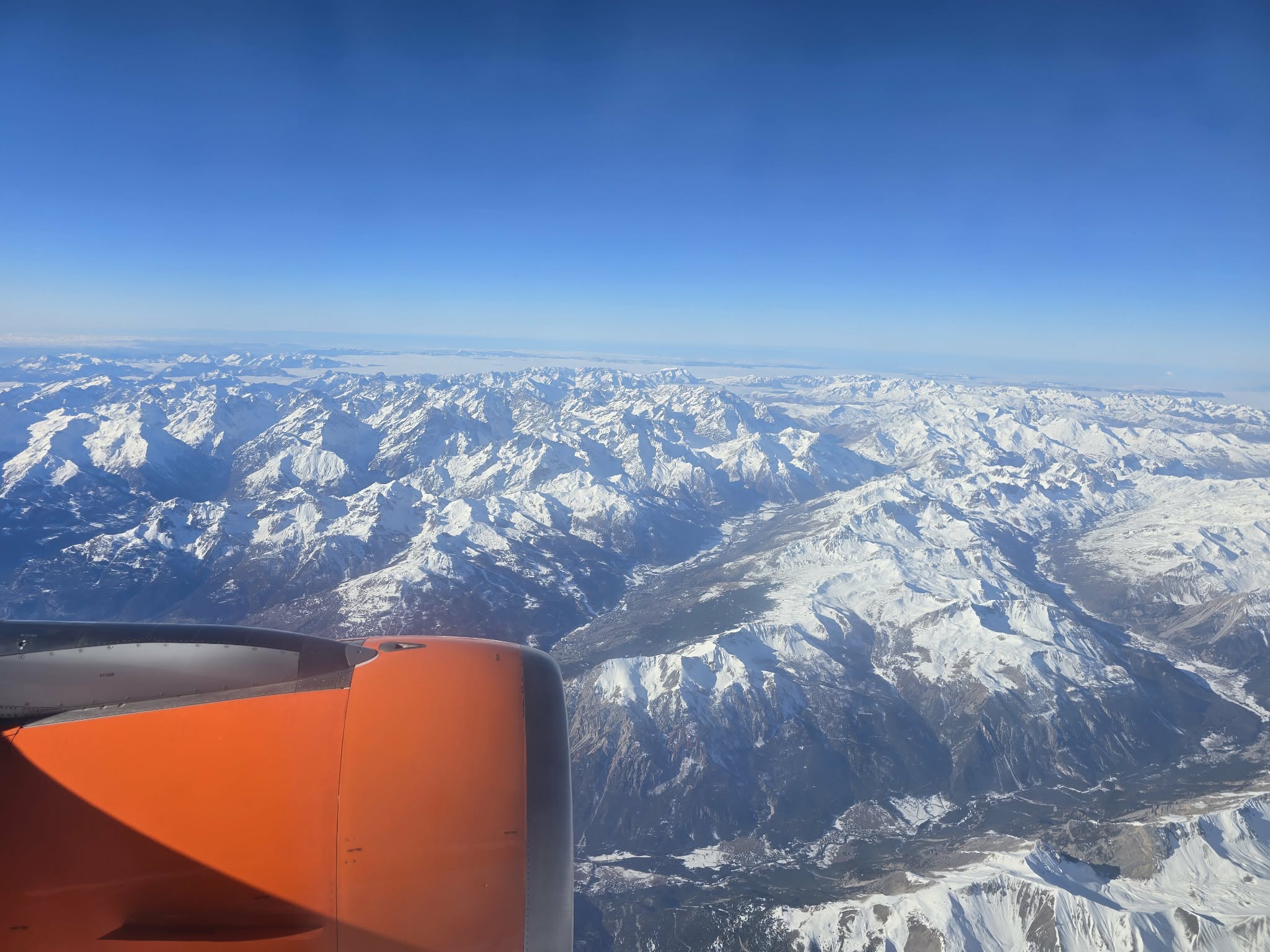
You could say the same thing about flying in the US as I love flying over places like the Rocky Mountains, New York City, or the desert, but flights in Europe often offer stunning scenery. Think of the Alps (photo above), Mediterranean coastlines, Irish cliffs, or patchwork countrysides - Window seats in Europe can be spectacular.
Smaller Airports
Many European airports feel more compact, easier to navigate, and in many cases, have faster security lines. In all honesty, we have never had a lengthy security line (even in CDG, but it helped we were flying early in the morning) and have found signs easy to follow while navigating airports. Dublin Airport is a perfect example of a small airport that functions as a major gateway between the US and Europe (see Aer Lingus review linked here). This isn’t to downplay the humongous airports like Paris CDG or London Heathrow, but overall there are a lot of smaller airports that play major roles when flying throughout Europe.
Things That Drive Me Crazy
Carry-On Rules That Change Every Airline
Budget airlines are extremely strict about baggage rules, even more so than Spirit Airlines (see my review of Spirit here). As I mentioned earlier when discussing the “ridiculously cheap flights”, more often than not at base fare, only a small personal item is free. Not your seat, just a small personal item. Seat selection, carry-on bags, checked luggage, water, snacks, and anything other than a place for you to sit (at their choosing) and a small personal item will cost you extra. If exploring a new city for a weekend and a backpack will suffice, absolutely enjoy that cheap fare. Just be careful that your backpack will fit in their sizer at the gate because, yes, they will check it before letting you on the plane. That goes for all carry-on items, even the ones you’ve paid extra for. Another maddening concept is that the budget airlines do not have a consistent size allowance from airline to airline. We’ve flown easyJet a handful of times and our backpacks and carry-on suitcases fit just fine, but if you read Ryanair’s allowance page, their carry-on size is several centimeters smaller! If you do not choose to check bags at the time of booking and your luggage does not fit in the sizer, you will be fined an exorbitant amount that is often more expensive than the airfare itself.
Boarding Can Feel Like a Free-for-All
I complain a lot about “gate flies” while boarding planes in the US, and I never thought it could get worse. Somehow just uttering or even thinking the words “it can’t get worse than this” just means it absolutely will. My annoyance with the boarding procedure often found in Europe boils down to three basic things: 1) Gates sometimes become crowded quickly, 2) Everyone lines up early even though seats are assigned, and 3) if boarding groups are even printed on your ticket, it may not really mean anything. This can feel chaotic compared to structured boarding groups (which are already chaotic when everyone swarms the gate).
Gates being crowded are a direct result of the seating areas not being scaled in proportion to the number of seats on a plane. Recently, when flying out of Nice, the gate had maybe 60 seats while the Airbus A320 we were about to board seated roughly 180 passengers. We don’t need to do the math to imagine what the gate area looked like.
As a result, everyone just started lining up 45 minutes before the flight even started boarding. I have to give credit where credit is due, as the line was an orderly single file line (something I’ve never seen in a US airport), but it led to a lot of confusion as passengers of other flights were trying to make their way past. We had comfortable seats and I was determined not to move until the line actually started moving. We had assigned seats so why should I join the queue to nowhere?
Lastly, we recently had an experience flying from Vienna on Austrian Airlines. Steps one and two from above both played out to perfection with an overcrowded gate and a lengthy line 30 minutes before the flight. I started to get a little antsy because we were in like the 3rd or 4th boarding group according to the screens (whatever group came after first class and the various priority boarding groups) and there was no way the probably 100 people lined up in front of us were in first class. Once they started boarding, I was thinking back to so many times in the US having to push through gate flies, but as soon as they finished the first few groups, they announced all the remaining boarding groups could now board. Like…what? Why even have boarding groups if they mean nothing? More on our Austrian experience coming up next.
Remote Gates and Bus Boarding
I know I started out giving Austrian Airlines a less than glowing review, but trust me, I do actually love Austrian Airlines. Anyway, continuing the story, once the madness of approximately 200 passengers converging on the boarding gate all at once was sorted out, we were excited to be heading down the jet bridge. Well, we made it all of maybe 50 feet before coming to a complete stop. You’re probably thinking, “yeah, so what? This happens all the time in the US.” You are absolutely right, it does happen, but not like this. We were standing for 20 minutes without moving an inch. People were grumbling, sitting down, and looking around every which way. When we finally did start moving, we were greeted with a set of stairs and an overcrowded bus. I will admit that it did feel pretty awesome watching the people who had impatiently bombarded the gate agents get squeezed all the way into the center of the bus as now they would be the very last off the bus and onto the plane, but the whole experience just adds to the disorganization. Crowd the gate, wait in a crowded jet bridge, pack into a bus, and then have an unorganized mad dash onto the plane once the bus stops – Remind me, what was the purpose of having those boarding groups again?
Hidden Fees Everywhere
I touched on this earlier discussing carry-ons, but budget airlines advertise super cheap fares…
…but then charge for, well, literally everything! We’ve already discussed luggage and the lack of any amenities such as the basic human need of water is no different than the Spirit business model
(once again, see my Spirit review - *spoiler, they aren’t as bad as I keep making them sound in this article*), but Ryanair takes the fees another step farther.
Gone are the days of arriving at the airport and checking in with a friendly agent. We recently booked a flight with Ryanair (future review sure to come)
and have since been warned that if we fail to download their app and check-in digitally to receive our boarding passes, there will be a minimum £20
(and at other airports upwards of £55) fee just to receive a small piece of paper. In this such case, apparently a piece of paper costs more than a £39 flight.
Gate Announcements at the Last Minute
Sometimes the gate isn’t announced until a certain time from departure and we’re not talking about arriving at the airport five hours early and not having a gate. On a flight from London Luton, our gate wasn’t even announced until the boarding time indicated on our boarding pass. On one hand, airports then feel a bit more like a shopping mall or train station with large, open areas, but on the other hand, it can lead to sudden crowds and people rushing across the terminal. I guess this strategy favors the people who test the airport theory by trying to see just how close to departure they can arrive at the airport.
Bonus: Boarding From Both the Front and Back
One thing I absolutely love about flying in Europe is how many airlines board and deplane from both the front and the back of the aircraft. Instead of everyone funneling through a single door, passengers sitting toward the rear of the plane can use the back stairs while those in the front board normally through the forward door. It’s a simple concept, but it can make the whole process dramatically faster.
When everyone follows the signs and heads toward the correct door, the system works beautifully. Boarding and deplaning can happen in a fraction of the time compared to the single-door process many travelers are used to in the United States.
Of course, this is also where things can occasionally go off the rails. Every now and then, passengers ignore the signs and pile into the wrong aisle, which leads to people climbing over each other or trying to squeeze past rows that aren’t even close to their seats. When that happens, the whole system turns into a bit of organized chaos.
Still, when it works properly, boarding from both ends of the aircraft might be one of the smartest and most efficient ideas in commercial aviation.
Final Thoughts
Despite a few quirks, flying in Europe is still one of the best ways to explore the continent. Cheap flights and short travel times make it possible to visit multiple countries on a single trip. Once you learn the system, it all becomes just another part of the adventure.